
When a segment of nerve is missing, a graft bridges the gap — giving regenerating fibers a living scaffold to grow across and reach the other side.
Bridged
For regrowth
or processed graft
Sometimes the two ends of an injured nerve cannot be brought together without tension, or a segment of nerve is simply gone. In these cases, a graft is placed to bridge the gap. The graft acts as a guide — a scaffold that regenerating fibers grow through to reach the far end.
Grafts may come from a patient’s own expendable sensory nerve (autograft) or from a processed nerve allograft. Dr. Michaeli selects the approach based on the gap length, the nerve involved, and the function to be restored.
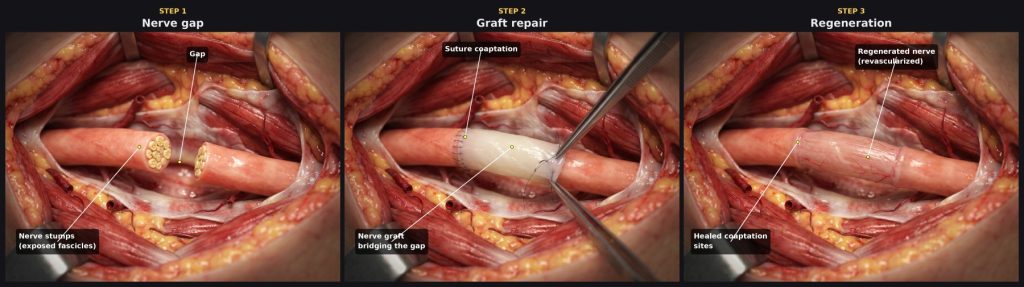
Fig: The grafting sequence: a gap in the nerve (left), the graft bridging it (center), and fibers regenerating across (right).
When a segment is missing or the ends cannot meet without tension.
Older injuries where the nerve ends have retracted often need a graft.
After removing a neuroma-in-continuity, a graft can restore continuity.
The healthy nerve ends are identified and the true defect length is measured.
An appropriate autograft or processed allograft is prepared to match the gap.
The graft is coapted to both ends under the microscope, tension-free.
The reconstruction is protected as fibers begin to regenerate across the graft.
Peripheral nerve surgery is its own discipline. Dr. Michaeli has dedicated his practice to the nerves, with fellowship-level training and thousands of nerve procedures.
Nerve work is measured in millimeters. Every repair is performed under high-magnification with microsurgical instruments and the latest reconstructive techniques.
Many patients arrive having been told nothing more can be done. A dedicated nerve evaluation often reveals options that general specialists do not offer.
The graft junctions are protected while healing begins.
Fibers must cross two coaptation points, so recovery is gradual but steady.
Sensation and movement return as fibers complete the journey.
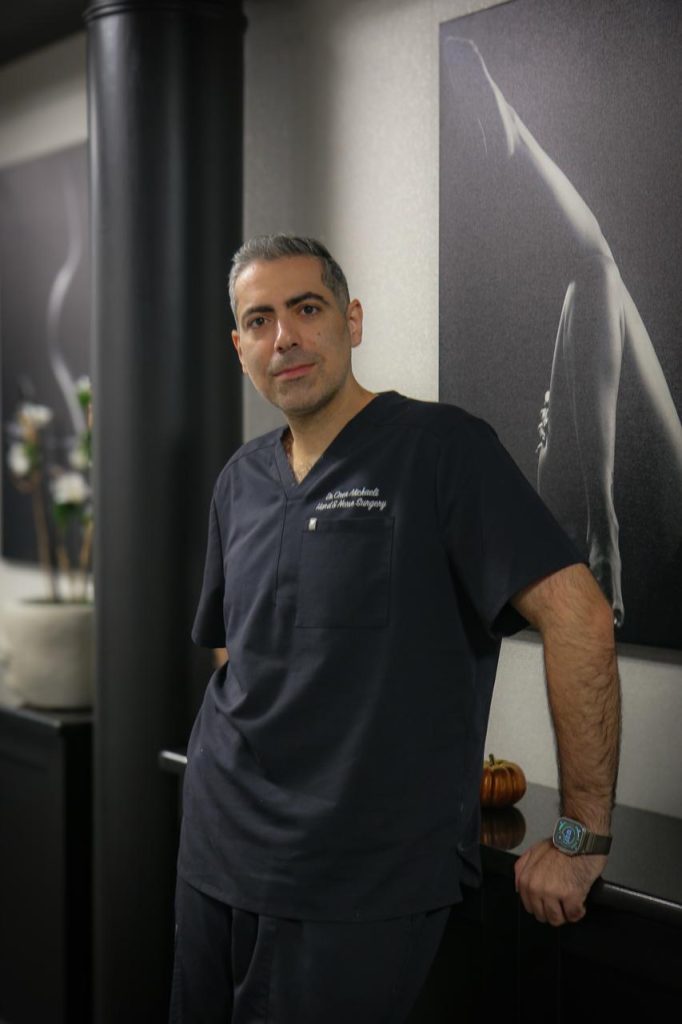
Peripheral Nerve & Brachial Plexus Surgeon · New Jersey & New York
Dr. Michaeli is among the most experienced and trusted peripheral nerve specialists on the East Coast, combining board-certified hand surgery expertise with dedicated peripheral nerve training. He has helped patients across the region regain function when they were told nothing more could be done.
Most peripheral nerve procedures are medically necessary and covered by insurance. Our team will help you understand your benefits and assemble the documentation your plan requires.
Why some nerves need a bridge, how grafts are chosen, and what recovery looks like.
A short explainer video from Dr. Michaeli will appear here. Replace the poster with your YouTube or Vimeo embed when ready.
Why some nerves need a bridge, how grafts are chosen, and what recovery looks like.
A short explainer video from Dr. Michaeli will appear here. Replace the poster with your YouTube or Vimeo embed when ready.
“After years of being told my pain was something I’d have to live with, Dr. Michaeli found the nerve causing it and fixed it.”
Neuroma surgery
“I had given up hope of using my hand again. The nerve transfer gave me back movement the other doctors said was gone.”
Nerve transfer
“The carpal tunnel release was quick and the night pain was gone immediately. I only wish I’d done it sooner.”
Carpal tunnel release